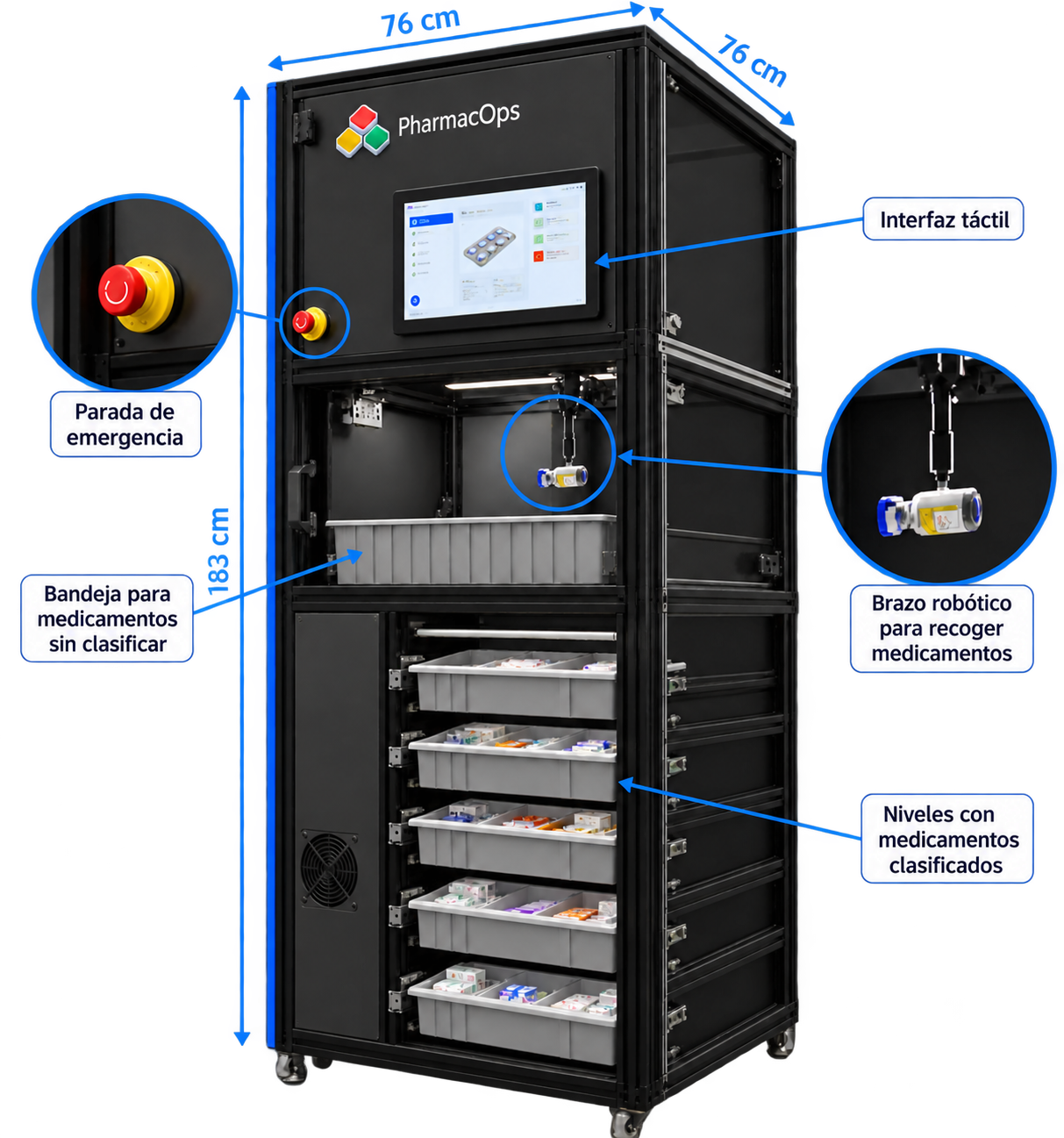
Handling a return means identifying the item, deciding where it belongs and recording what happened. PharmacOps brings these tasks into one workflow that moves clear cases forward and flags those needing attention.
Capture
Gather the sample evidence.
Identify
Suggest a reference and flag uncertainty.
Route
Assign a compatible position.
Trace
Keep the decision and every movement on record.
STATUS AND DESTINATION
Classification by status. Restocking by destination.
The colour indicates the assessment outcome. The destination identifies where the approved unit will be restocked.
PHARMACOPSUNIT STATUS
AprobadoChecks passed
Aprobado
Identity and conditions verified.
The engine will cross-check identity, strength, batch and expiry against the catalogue and protocol. If integrity and required conditions meet the criteria, it will assign the restocking destination and record the decision.
Configured restocking destination · per-item record
Review
Missing data or partial opening.
An unreadable batch, conflicting sides or partially opened cavities will prevent approval of that unit. Its location, evidence and missing information will be retained for review after filling is complete.
Probable destination · review after filling
Discard
Expired or compromised unit.
A verified expired date or conclusive damage will separate the unit from the restocking flow. The system will retain the reason and location until removal is confirmed. Uncertain damage will remain under review.
Confirmed removal · reason and history retained
STATUS AND DEVELOPMENT
Start with software. Scale into physical automation.
A single model connects decisions, positions and movements. Physical automation will be introduced in modules once the process and its rules have been validated.
Equipment components and layout
PHASE 1 · SOFTWARE
Organise the workflow.
The demo already explores sorting, destinations, trays and traceability. Physical movement in the planned MVP will be manual.
Visual demo and automatic mode
Available
Reservations, states and logs
Working with examples
Live capture, catalogue and identification
Awaiting integration
PHASE 2 · PLANNED DEVELOPMENT
Automate movement.
Input, sorting and physical execution can be added as modules using the same position model. Each module will require its own testing.
Phase 2 concept diagram
Explore the modular architecture Capture, identification, destinations and traceability +
CAPABILITY / 01
Capture and evidence
Collects the image and preserves the information observable in it.
Planned input
Planned individual capture
Planned output
Observable evidence
Current status
In development
Product outline. The status shows what has been tested in the demonstration and what requires integration.
Learning from exceptions An opportunity for future improvement +
Every resolved exception leaves a useful signal.
The final reference, reason and any correction help identify where the process fails and guide improvements. Professional judgement comes in when a case needs review.
Proposal
Exception
Resolution and reason
Structured feedback
Evaluation and improvement
The demo records these signals. Model evaluation and training remain pending; there is no real-time machine learning.
ORIGINS AND VALIDATION
A hackathon demo. A project awaiting validation.
Born from LabORA Challenge 6 on medicines returned to hospital pharmacy.
We aim to assess the workflow with professionals and prepare future tests using authorised samples.
We are looking for hospitals, pharmacy services and healthcare professionals to help validate PharmacOps against real medicine return, identification and sorting processes.
We want to understand today's workflows first-hand, identify real needs and explore future pilot studies.
Robotics, automation and technology
We are looking for engineers, robotics companies, integrators, technology providers and entrepreneurs who want to help develop the physical side of PharmacOps.
From computer vision and sensors to sorting and automation systems, we want to build an architecture ready to scale into real environments.
Investors
PharmacOps is at an early stage and open to discussions with investors interested in healthtech, medtech, robotics, deeptech and automation.
We are looking for partners who share our vision of transforming a largely manual pharmaceutical process into scalable technological infrastructure.
Other collaborators
Do you work in pharmaceuticals, healthcare, technology or research and think we could build something together?
We welcome universities, technology centres, researchers, suppliers and others who can contribute knowledge, technology or new collaboration opportunities.
FREQUENTLY ASKED QUESTIONS
The essentials, clearly explained.
Does the MVP already include a robot?+
No. The planned first phase combines a mobile camera, software and physical trays with human placement. Connected capture and mechanical automation are future integrations.
What does the demo demonstrate?+
A sample's journey to its destination: identification, grouping by zone and traceability in T01. Follow it step by step or use automatic mode with speed and pause controls.
Does it learn automatically from each review?+
The demo records the responsible person, decision, reason, conflicting evidence and corrections. This information could support future evaluations; today there is no automatic training, learning pipeline or measured accuracy improvement.
What happens when a sample cannot be identified?+
The case remains located and awaiting review while subsequent samples can continue. Intervention focuses on that exception; insufficient evidence does not become a confirmed identity.
Does a green result mean the medicine can be dispensed?+
No. Green indicates suitability to continue in the logistics workflow; dispensing requires its own professional procedure.
Is it deployed or endorsed by Hospital Clínic?+
It is not presented as a deployment or an endorsed solution. Hospital Clínic promotes the challenge that inspired the project.

 EN